
How to Start an AI Automation Agency in 2026: A Practical Playbook
How to start an AI automation agency in 2026: pick a niche, package one offer, choose n8n, Make or Zapier, land first clients and run delivery well.
By Kishan Makani, Founder & CEO
Updated · Published · 10 min read
Short answer
To start an AI automation agency, pick one niche and one painful process, package it as a fixed-scope offer with a setup fee and a monthly retainer, build on one platform you know well (n8n, Make, Zapier, or Vapi/Retell for voice), win three to five clients through direct outreach, and set up monitoring, reporting and invoicing before you scale.
Key takeaways
- Niche first: one industry and one process beats a menu of every possible automation.
- Sell a packaged outcome with a setup fee plus a monthly retainer, not hours.
- Standardise on one workflow platform for your first year; add voice AI only if your niche needs it.
- Decide early who owns the platform accounts and API keys, and write it into the contract.
- Monitoring, client reporting and invoicing are what turn one-off builds into recurring revenue.
Most people who try to start an AI automation agency do not fail at building workflows. They fail at the business around the workflows: vague offers, one-off projects that never renew, silent failures nobody notices, and invoices chased by hand. This guide covers both halves, in the order I would do it again.
It assumes you can already build a working automation in at least one tool. If you cannot yet, spend a few weeks building for yourself or a friendly business first. Selling before you can deliver is the fastest way to burn your first referrals.
What is an AI automation agency?
An AI automation agency designs, builds and runs automated workflows and AI agents for other businesses. Typical work includes lead routing, CRM updates, document processing, AI email triage, reporting pipelines and, more and more, voice agents that answer or place phone calls.
The key word is runs. A freelancer delivers a workflow and leaves. An agency stays responsible for it: it watches for failures, fixes breakages when an API changes, reports results and bills monthly. That ongoing responsibility is what clients pay a retainer for, and it is where your margin lives.
Is starting an AI automation agency still worth it in 2026?
It is worth it if you treat it as a service business, not a trend. The tools are cheaper and more capable than ever: n8n can be self-hosted, Make and Zapier both have usage-based plans, and voice platforms like Vapi and Retell bill per minute. That lowers your cost to start, but it also lowers the barrier for everyone else.
What has not become easier is understanding a specific industry's process well enough to automate it safely, then owning it month after month. Agencies that win in 2026 compete on that, not on knowing which node to drag onto a canvas.
How do you start an AI automation agency, step by step?
- Pick a niche and one process. Choose an industry you understand and a process that is repetitive, rules-based and tied to money, such as lead follow-up for home-service companies or intake for law firms.
- Package a fixed-scope offer. Define what you build, what it connects to, what you monitor and what the client gets each month. Give it a name and a price.
- Choose your core platform. Standardise on one workflow tool, and add a voice platform only if your offer needs phone calls.
- Build a demo on real-looking data. A working demo of your packaged offer sells better than a portfolio of unrelated experiments.
- Land three to five clients by direct outreach. Talk to owners in your niche, show the demo, and offer a short paid pilot.
- Set up operations before client six. Monitoring, alerts, client reporting, contracts and invoicing should be in place before volume makes them painful.
- Turn delivery into a playbook. Document every build so the next client in the same niche takes half the time.
How do you choose a niche for an automation agency?
Look for three things: a process that happens many times a week, a clear cost when it goes wrong (a missed lead, a late invoice, a lost booking), and software the client already uses that has an API. If any of the three is missing, the automation is hard to sell or hard to build.
Your own background is usually the best source. If you worked in real estate, recruiting, e-commerce or accounting, you already know the language, the tools and the annoying manual steps. That knowledge makes your discovery calls sharper than a generalist's.
Which platform should a new automation agency build on?
Pick the platform that fits your clients and your skills, then stay on it long enough to build reusable templates. Switching tools every month resets your learning curve. The table compares the common starting choices by how they bill and where they tend to fit.
| Platform | How usage is billed | Where it tends to fit | Watch out for |
|---|---|---|---|
| n8n | Per workflow execution on Cloud; can also be self-hosted | Complex logic, AI agents, technical teams, data you want on your own servers | Self-hosting means you own uptime, updates and backups |
| Make | Credits, usually one per module action | Visual multi-step scenarios, clients who want to see the flow | Credit use grows with steps and loops, so model it before quoting |
| Zapier | Tasks, counted per successful action step | Non-technical clients, huge app catalogue, quick wins | High-volume flows can get expensive on task-based pricing |
| Vapi | Per minute, plus model and telephony costs | Developer-led voice agents with custom tooling | Several cost components per call; track them per client |
| Retell | Per minute of connected call, by component | Voice and chat agents with built-in testing and analytics | Concurrency limits and telephony costs at volume |
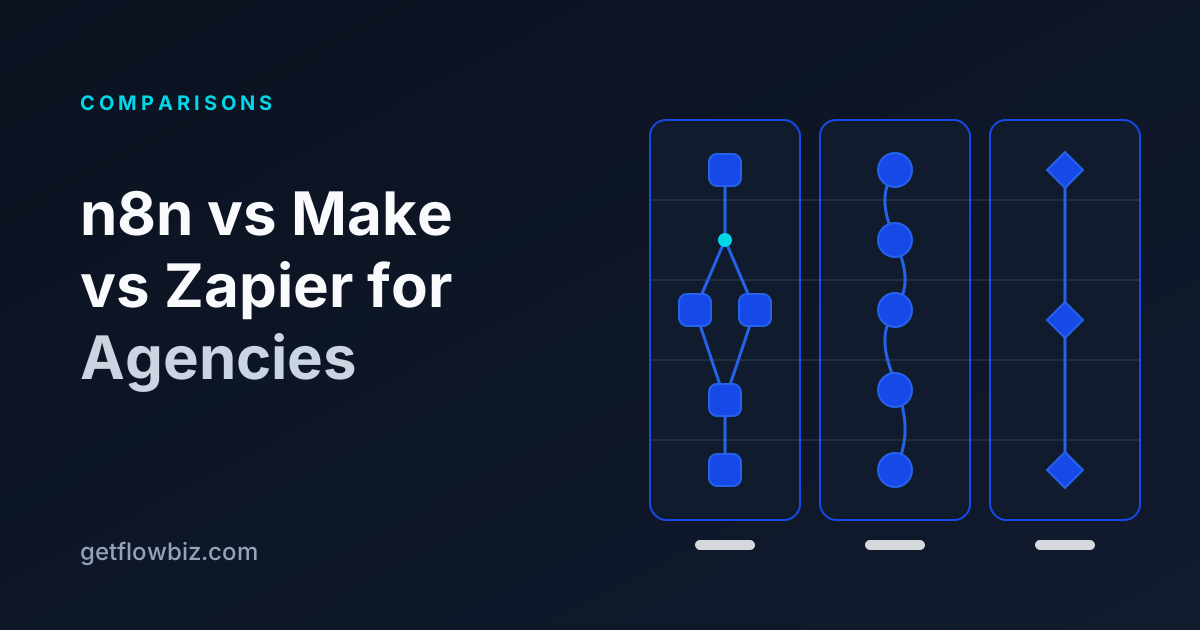
For a deeper look at the workflow tools, see our n8n vs Make vs Zapier comparison for agencies. If voice is part of your offer, the Vapi vs Retell guide covers the trade-offs.
What should your first offer include?
A good first offer is narrow enough to deliver in two to four weeks and valuable enough that the client feels the difference in the first month. It should spell out five things:
- The outcome: for example, "every web lead gets a reply and a CRM record within two minutes."
- The scope: which apps it connects, which edge cases it handles, and what is out of scope.
- The run phase: monitoring, fixes when a connected app changes, and a monthly results report.
- The price: a one-time setup fee plus a monthly retainer, with usage costs either included up to a limit or passed through.
- Ownership: who holds the platform accounts and API keys, and what happens to the workflows if the contract ends.
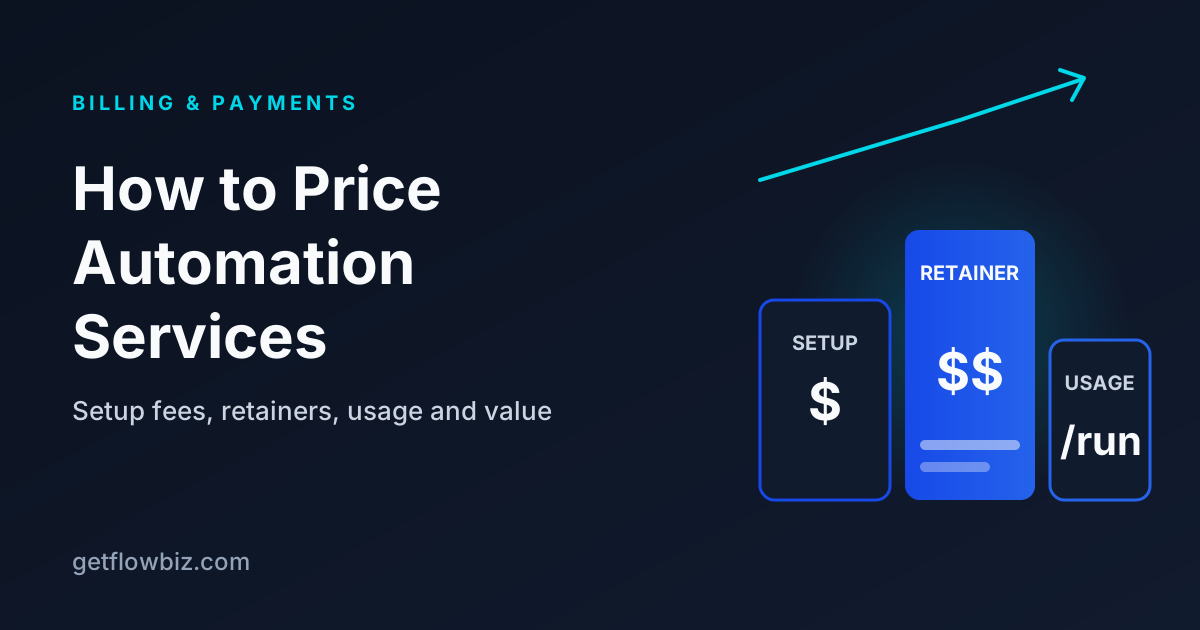
Pricing deserves its own article, and it has one: how to price automation services walks through setup fees, retainers and usage-based models with worked examples.
How do you get your first automation clients?
Your first clients will almost always come from direct conversations, not inbound marketing. Content and SEO compound over time, but they rarely pay your first month's bills.
- List 50 businesses in your niche that you can reach personally, through your network, local groups or LinkedIn.
- Lead with the problem, not the tech. "How do you follow up with leads that come in after hours?" opens more doors than "I build AI agents."
- Show a two-minute demo of your packaged offer running on sample data that looks like theirs.
- Offer a paid pilot with a short, fixed scope and a clear success measure agreed in writing.
- Report results at the end of the pilot in hours saved, leads handled or calls answered, then convert to a retainer.
Ask every happy client for one introduction. In a tight niche, owners talk to each other, and a single referral from a respected business is worth more than a hundred cold emails.
What does it take to run delivery once clients sign?
This is where new agencies get caught out. With two clients you can check each workflow by hand. With ten clients across n8n, Make and a voice platform, you cannot. Workflows fail quietly: an expired OAuth token, a changed field name, a rate limit. The client usually notices before you do, and that is how retainers get cancelled.
Before you pass five clients, put these in place:
- Failure alerts on every production workflow. n8n supports error workflows that fire when a run fails; other platforms have their own options.
- A single view of runs across clients, so you can see which client's automations are healthy without logging into five dashboards.
- Per-client costs, including platform usage, LLM tokens and telephony minutes, so you know your margin per account.
- A client-facing report or portal that shows what ran, what it saved and what is due.
- Invoicing and payment collection that does not depend on you remembering to send a PDF.
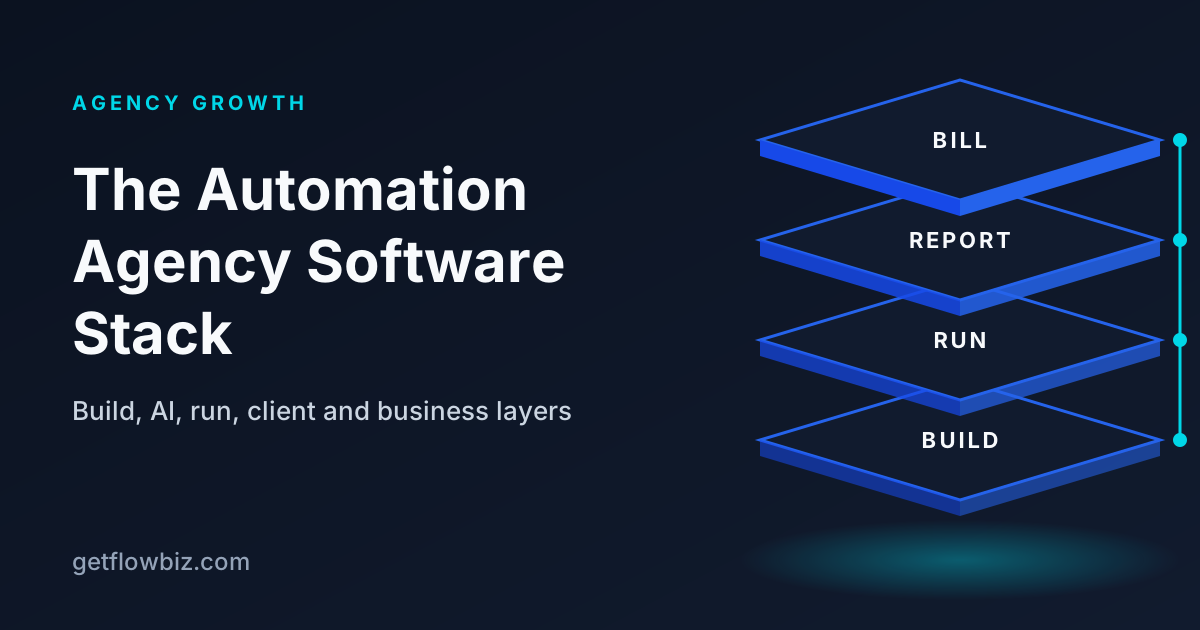
You can stitch this together with spreadsheets, a status page and a billing tool, and many agencies start that way. We built GetFlowBiz because we got tired of doing exactly that: it connects n8n, Make, Zapier, Vapi, Retell and 20+ other platforms by API key, sends failure alerts, tracks cost and margin per client, and gives each client a branded white-label client portal with invoices and online payment.
What mistakes sink new automation agencies?
| Mistake | Why it hurts | Do this instead |
|---|---|---|
| Selling "any automation" | Every project is custom, so nothing gets faster | Sell one packaged offer to one niche |
| Billing hourly | You earn less as you get faster | Setup fee plus a monthly retainer tied to an outcome |
| No monitoring | Clients discover failures before you do | Alerts on every production workflow from day one |
| No reporting | The client forgets what the automation does for them | A monthly report with hours and money saved |
| Undefined account ownership | Disputes when a contract ends | Write ownership and handover terms into the contract |
| Absorbing usage costs | Margin disappears as volume grows | Track platform, LLM and telephony costs per client |
What should your first 90 days look like?
- Days 1 to 15: choose the niche and process, write the one-sentence offer, build the demo.
- Days 16 to 45: run 20 or more conversations, sign one or two paid pilots, deliver them carefully.
- Days 46 to 75: convert pilots to retainers, collect results, ask for referrals, document the build.
- Days 76 to 90: set up monitoring, reporting and invoicing so client six is no harder than client two.
Ninety days is not a promise of revenue. It is a rhythm that forces you to talk to buyers, deliver something real and build the operating basics while the stakes are still small.
How do you prove value so clients renew?
Renewals depend on the client seeing results without having to ask. The simplest method is to agree on a number of minutes each run saves, multiply by runs and by the client's hourly value, and send that figure every month alongside run counts and any incidents. Our guide to proving automation ROI to clients shows the formula and a report template.
Where GetFlowBiz fits
GetFlowBiz is the operations layer for agencies once you have clients: connect your platforms by API key, monitor every workflow and voice call, see cost and margin per client, and give clients a branded portal with live results, invoices and 12 payment methods at 0% platform fee. It is free right now through our Founding Member program, and the first 100 accounts stay free forever. You can compare it with other agency portals, see the full features, or sign up free and connect your first platform in a few minutes.
Frequently asked questions
How much does it cost to start an AI automation agency?
Starting an AI automation agency can cost very little: a workflow platform plan (or a self-hosted n8n server), a domain, and a contract template. Usage costs such as executions, credits, LLM tokens or voice minutes grow with client volume, so pass them through or include them up to a limit in your pricing.
Do I need to know how to code to start an automation agency?
You do not need to be a software engineer to start an automation agency, but you need to be comfortable with APIs, JSON, webhooks and debugging. Basic JavaScript or Python helps a lot, especially on n8n, where code nodes handle the edge cases that visual steps cannot.
Which platform is best for a new automation agency: n8n, Make or Zapier?
There is no single best platform for every automation agency. n8n suits complex logic and self-hosting, Make suits visual multi-step scenarios, and Zapier suits non-technical clients who need many app integrations. Pick one that fits your niche and stay on it long enough to build reusable templates.
How many clients does an automation agency need to be sustainable?
The number of clients an automation agency needs depends on its retainer size and costs. Work backwards: divide your monthly income target plus business costs by your average retainer margin. Fewer clients on larger retainers are usually easier to serve well than many small ones.
Should an AI automation agency offer voice agents?
An AI automation agency should offer voice agents only if its niche has a clear phone problem, such as missed calls, after-hours bookings or appointment reminders. Voice platforms like Vapi and Retell bill per minute with several cost components, so track call costs per client before adding voice to a fixed retainer.
What tools does an automation agency need besides the workflow platform?
Besides a workflow platform, an automation agency needs failure monitoring and alerts, a way to report results to clients, per-client cost tracking, contracts, and invoicing with online payment. These can be separate tools or a single agency operations platform such as GetFlowBiz.
Sources
Founder & CEO, GetFlowBiz
Kishan builds GetFlowBiz, the client portal and operations platform for automation and AI agencies. He writes about running, pricing and reporting on automation work. More from Kishan